

Perceptyne bets on AI humanoid robots to reshape factory automation
Startup raises Rs 30 crore, creates 150+ jobs in Hyderabad
image for illustrative purpose
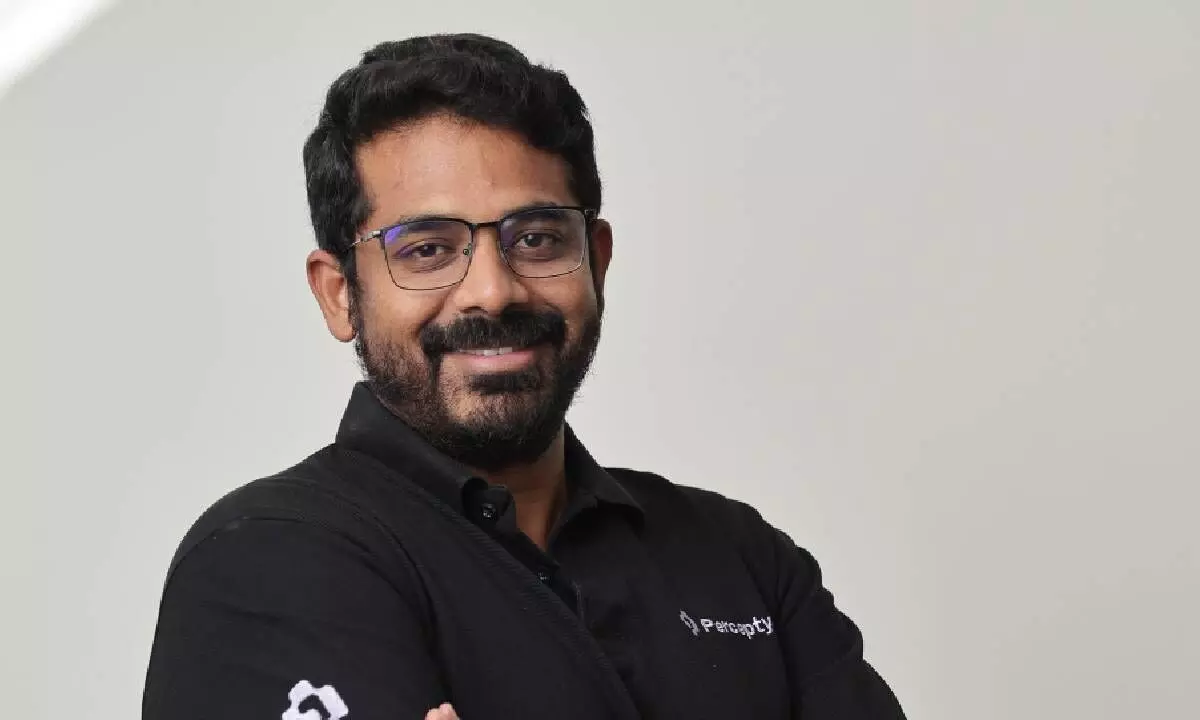
Hyderabad: Perceptyne, a Hyderabad-based deep-tech startup, is building AI-powered humanoid robots to transform industrial automation by enabling machines to perform complex, variable tasks traditionally handled by humans.
Co-founded by Jagga Raju Nadimpalli, Mrityunjay Shastri, and Aditya Jain, the company began full-time operations in 2022 after its incorporation in 2021. What started as a three-member founding team has grown rapidly into an organisation employing over 150 people in Hyderabad.
Perceptyne’s core focus is on developing industrial humanoid robots capable of executing “intelligent and dexterous tasks” on factory floors. These include assembly-line operations where variability and precision often limit the effectiveness of conventional automation systems.
“Conventional industrial robots are highly efficient at repetitive ‘pick-and-place’ operations, but they lack adaptability,” Nadimpalli explained. “Our robots are designed to perceive, analyse, and act in dynamic environments,” he noted.
Perceptyne claims to be among the few Indian firms developing robotics technology from the ground up. Its capabilities span the entire stack—from actuators and sensors to control systems, hardware, and AI-driven application software—positioning it as a vertically integrated deep-tech player in the robotics space.
Currently, the startup is working closely with automotive manufacturers and electronics manufacturing services companies, particularly multinational firms operating in India. These sectors are among the largest adopters of automation, and Perceptyne aims to bridge critical gaps where conventional robotics solutions fall short.
India imports around 9,000 robotic arms annually, with demand growing at nearly 50 percent CAGR. Perceptyne aims to reduce this dependence by offering locally developed solutions tailored to Indian industry needs.
The company operates a manufacturing facility in Gandimaisamma and maintains its R&D and corporate office in Kondapur, Hyderabad. Its operations span product development, testing, manufacturing, and analytics.
On the funding front, Perceptyne has raised nearly Rs 30 crore. Early-stage support of about Rs 5 crore came through pre-seed investments, including backing from T-Hub and government initiatives such as the Startup India Seed Fund. This was followed by Rs 25 crore in funding from institutional investors including India Quotient and DLU Capital, along with angel investors.
Looking ahead, the company plans to leverage both venture capital and government-backed initiatives, including India’s proposed Rs 1 lakh crore R&D fund, to scale its operations. Nadimpalli said Perceptyne aims to evolve into a multi-thousand-crore enterprise over the next eight to ten years, with a potential public listing as a long-term goal.
While current deployments are focused in India, the startup is already working with global clients that have manufacturing operations across geographies. This provides a pathway for expansion into markets such as the US, Europe, and Singapore.
Beyond industrial use, Perceptyne sees long-term potential in adapting its robotics technology for home environments, where intelligent machines could assist with daily tasks. “The same intelligence that enables robots to function in factories can eventually be adapted for home environments—handling chores like cleaning, organising, and assisting in daily tasks,” he said.
As India pushes to strengthen its domestic manufacturing ecosystem, Perceptyne reflects a broader shift toward indigenous innovation in robotics, an area critical to enhancing productivity and global competitiveness.





